Conditions at the hills right now, plus the coming week — so you know what to pack.
Now
24°C
Overcast
High / Low: 27° / 23°
Feels like29°C
Chance of rain99%Rain likely
Wind6 km/hLight breeze
UV index9Very strong UV
Sunrise: 05:32Sunset: 17:37
Updated 07:32 PM
What this means for your visit
Risk alerts
⚠Thunderstorms are forecast. Do not stay on the exposed deck when thunder is audible, avoid sheltering under trees, and expect boat trips and outdoor rides to be suspended.
⚠Heavy rain is expected. Inland roads turn slippery, low-lying sections can flood, and the view from the deck closes in quickly.
What to wear
•Rain is likely — pack a light raincoat or umbrella and expect wet, slippery ground.
•Sun and UV are strong — long sleeves, a hat and sunscreen are worth packing.
How to plan the day
•If thunder is audible, come down from the deck and wait it out at the lower complex or café.
•It will feel hotter than the thermometer suggests — pace yourself on the stairway and drink more water than you think you need.
•Soft, even light flatters photos and the climb stays cool — comfortable for a longer visit.
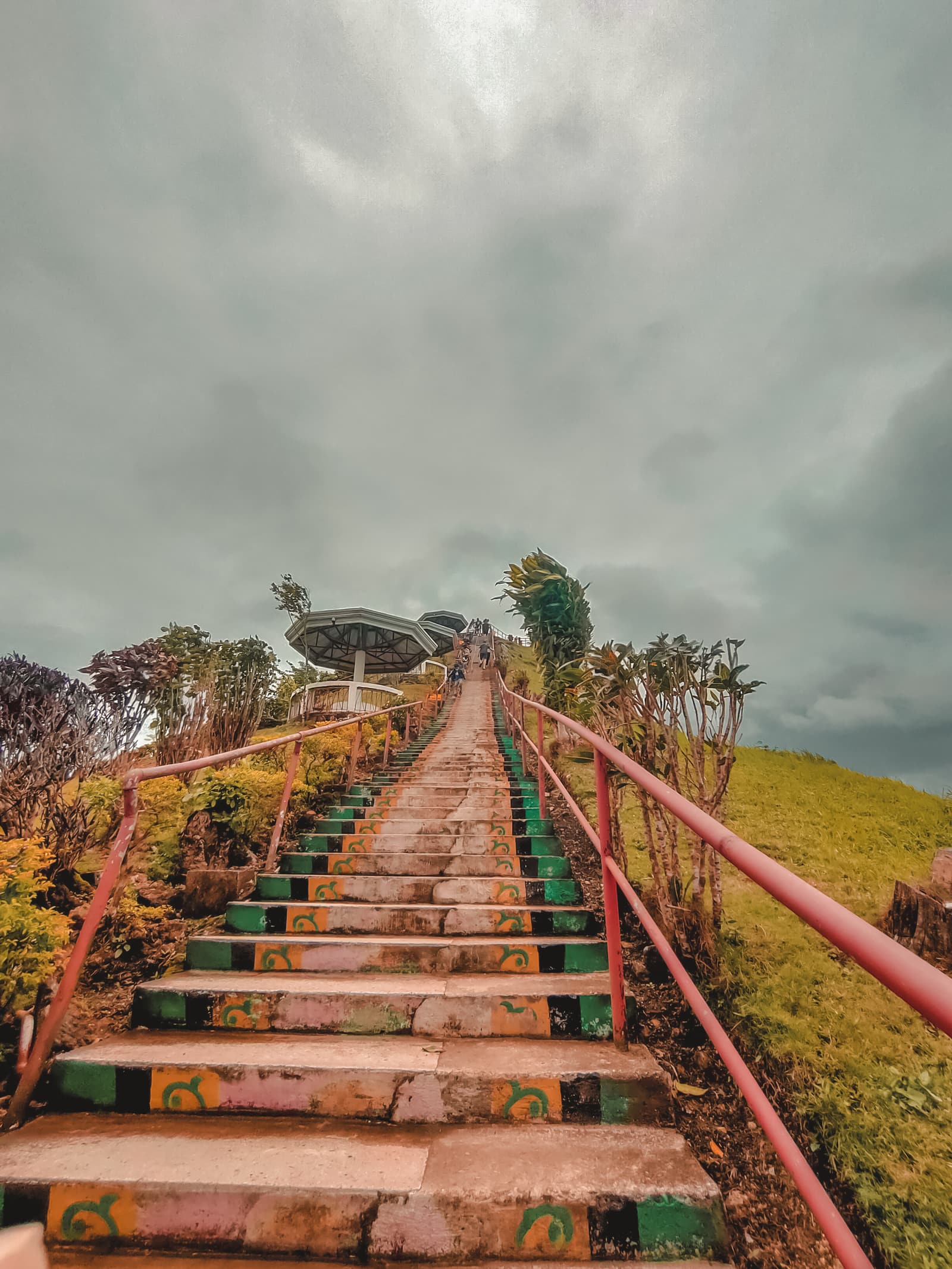
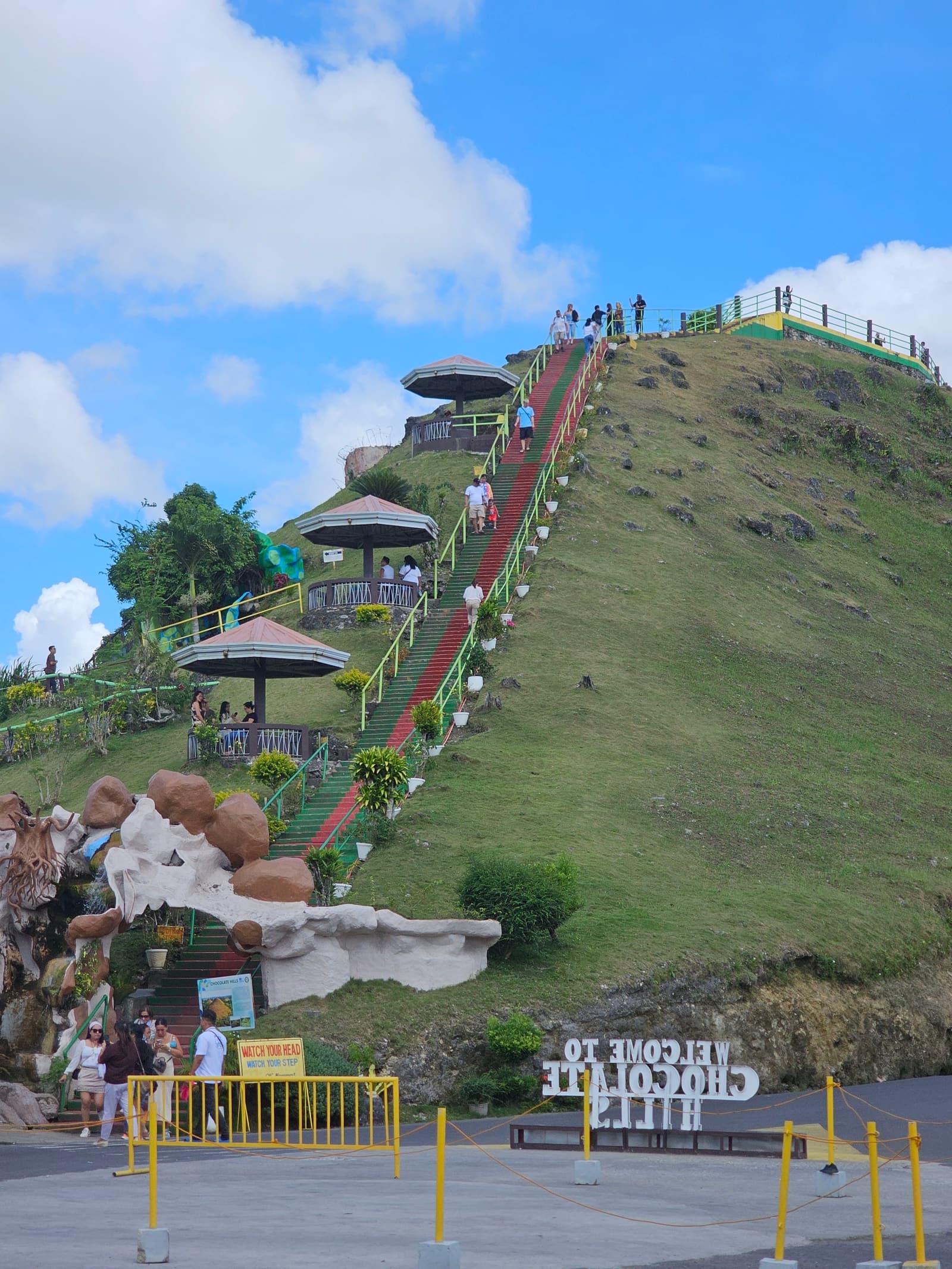
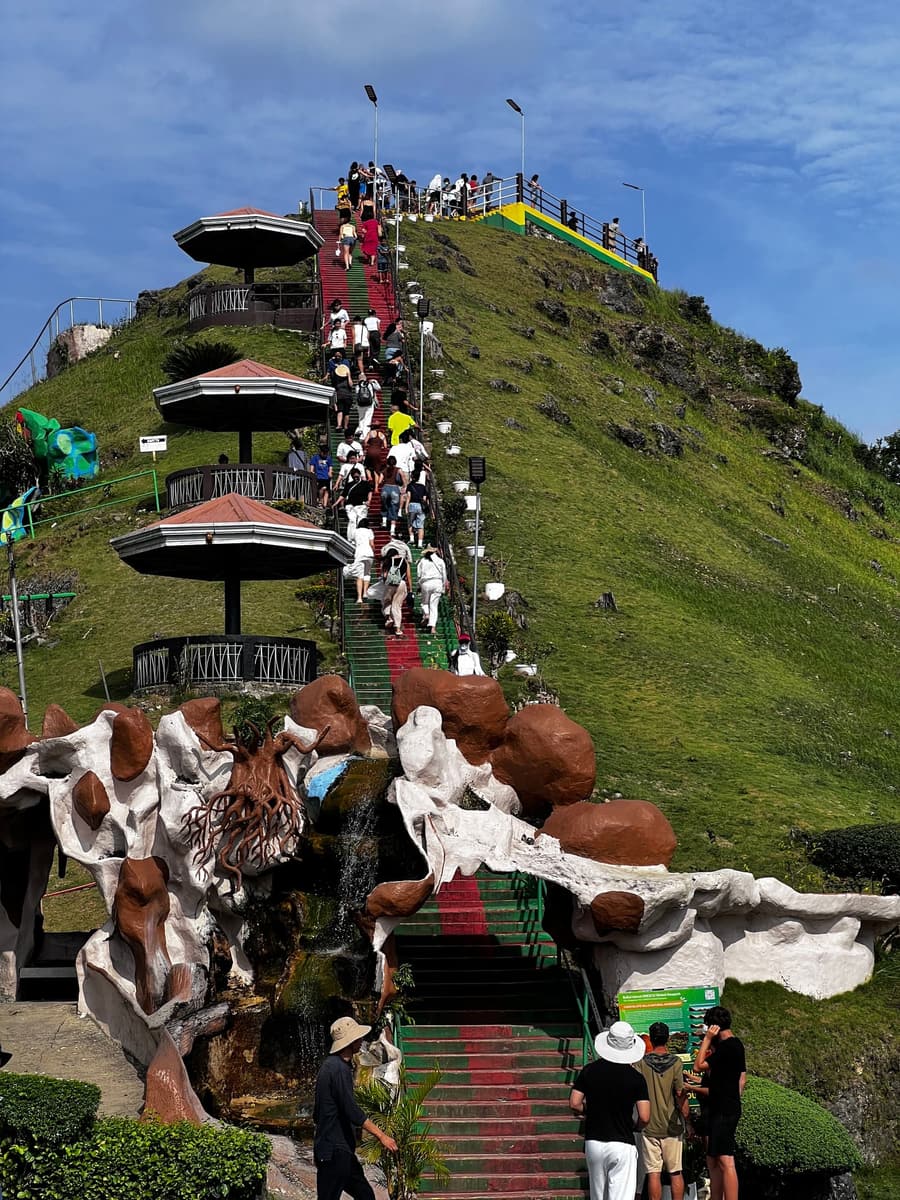
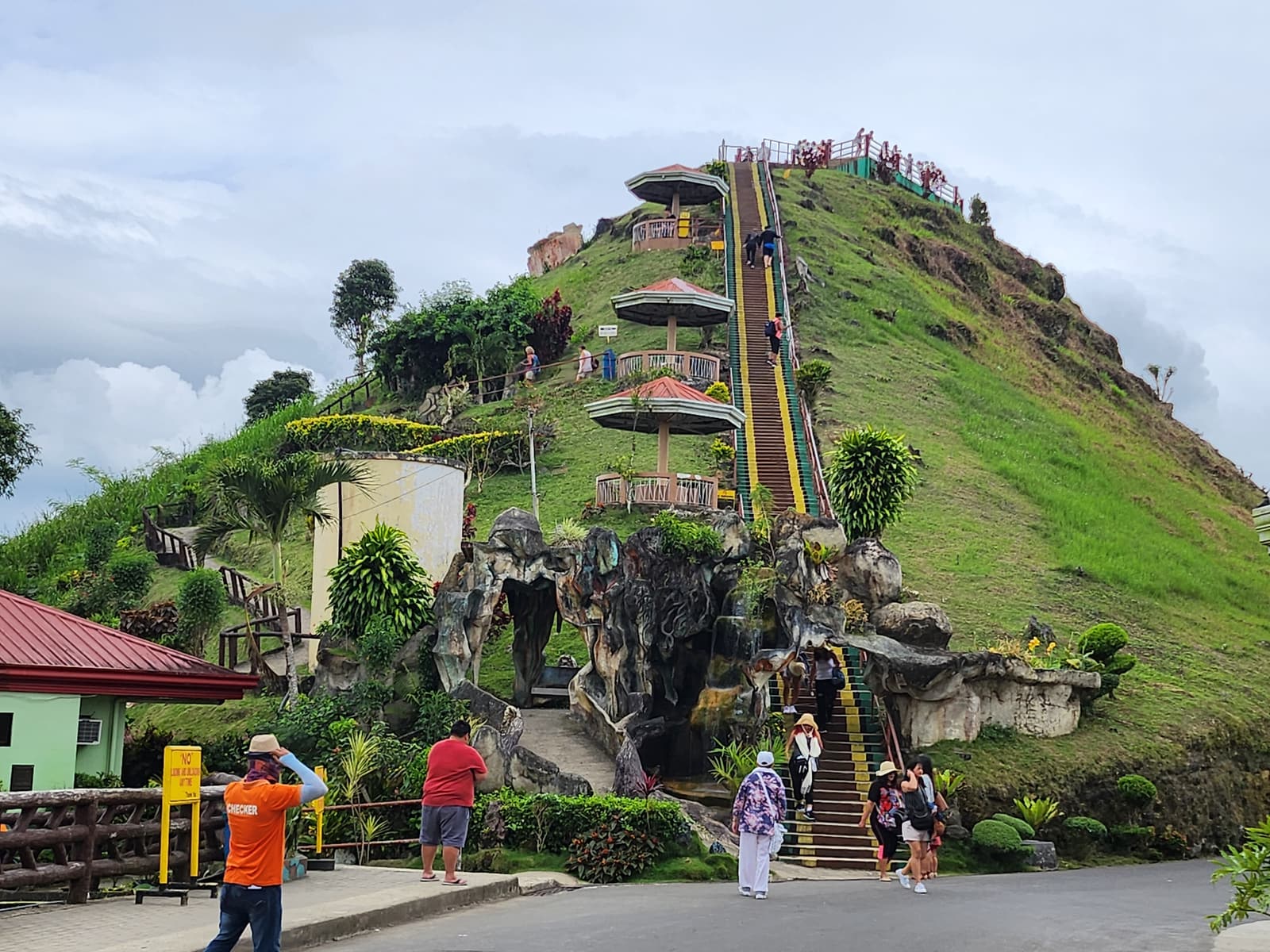
•The 214 steps and metal railings are slick after rain — climb slowly and hold the rail.
•Mornings are usually clearer and cooler than afternoons — the best window for the viewing deck.
What to bring
Folding umbrella
Sunscreen
Sunglasses
Sun hat
Drinking water
Shoes with grip
These suggestions are tuned to this landscape: an exposed hilltop viewing deck reached by 214 steps, inland roads, and island boat trips.
Next 7 days
Today
26
27°
23°
Severe thunderstorms
99%
Sun
27
29°
23°
Thunderstorms
99%
Mon
28
27°
23°
Thunderstorms
100%
Tue
29
29°
22°
Severe thunderstorms
100%
Wed
30
28°
22°
Drizzle
100%
Thu
1
28°
23°
Thunderstorms
100%
Fri
2
27°
22°
Drizzle
100%
About
About Chocolate Hills Complex
Welcome to Chocolate Hills Complex, widely recognized as the central Chocolate Hills. Located in the heart of Carmen, Bohol, Philippines, this destination serves as a primary hub for travelers visiting the region.
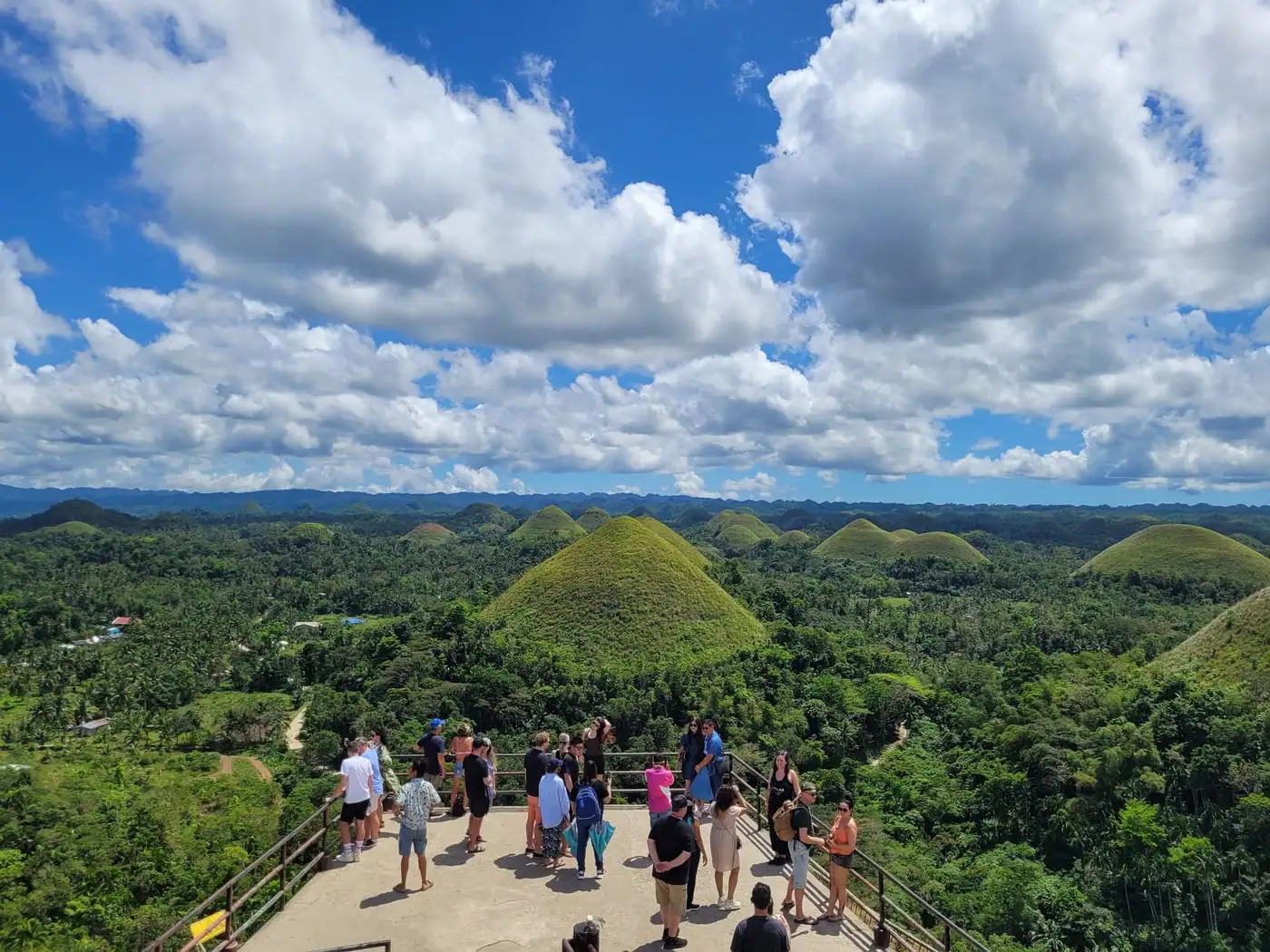
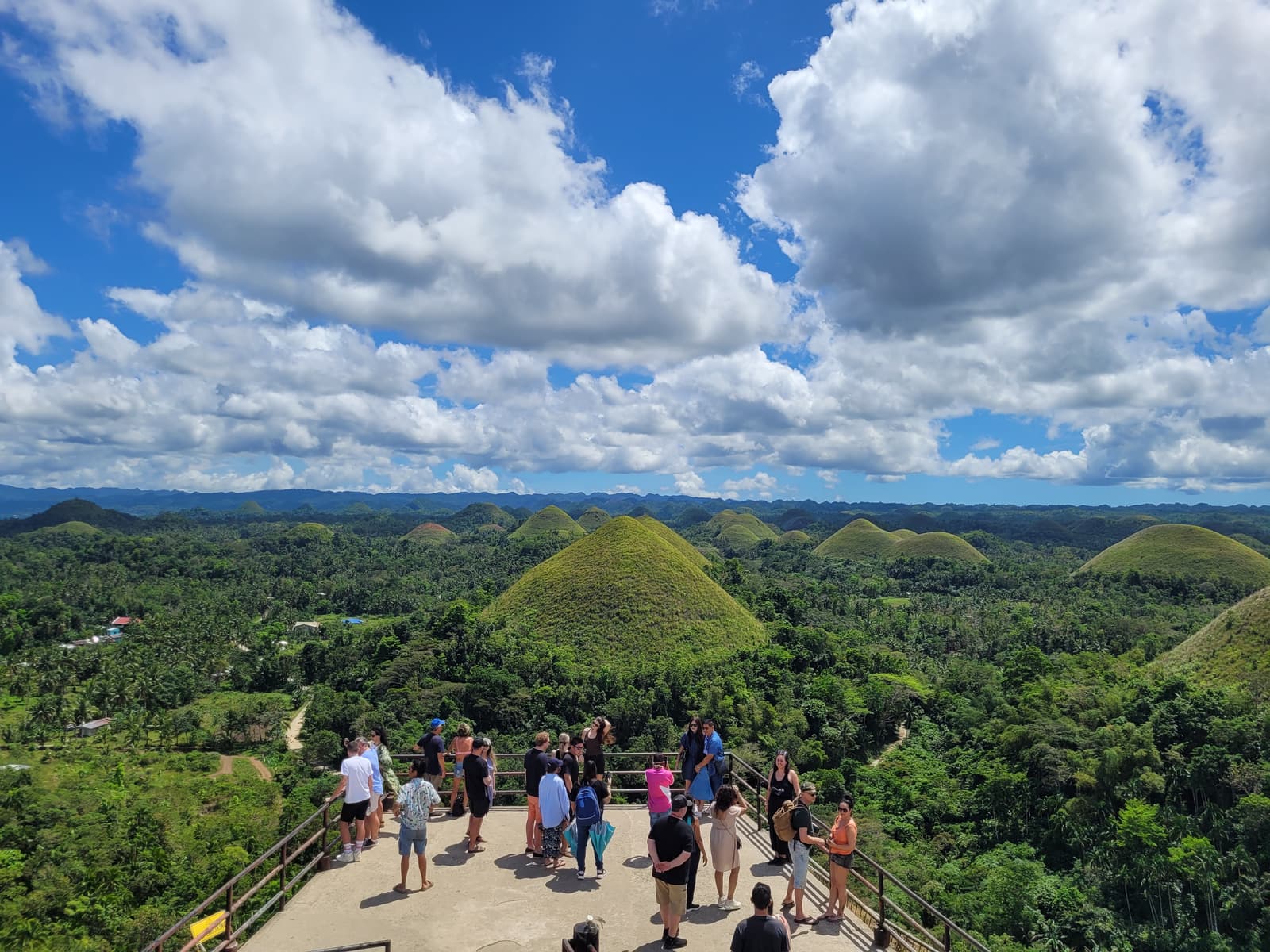
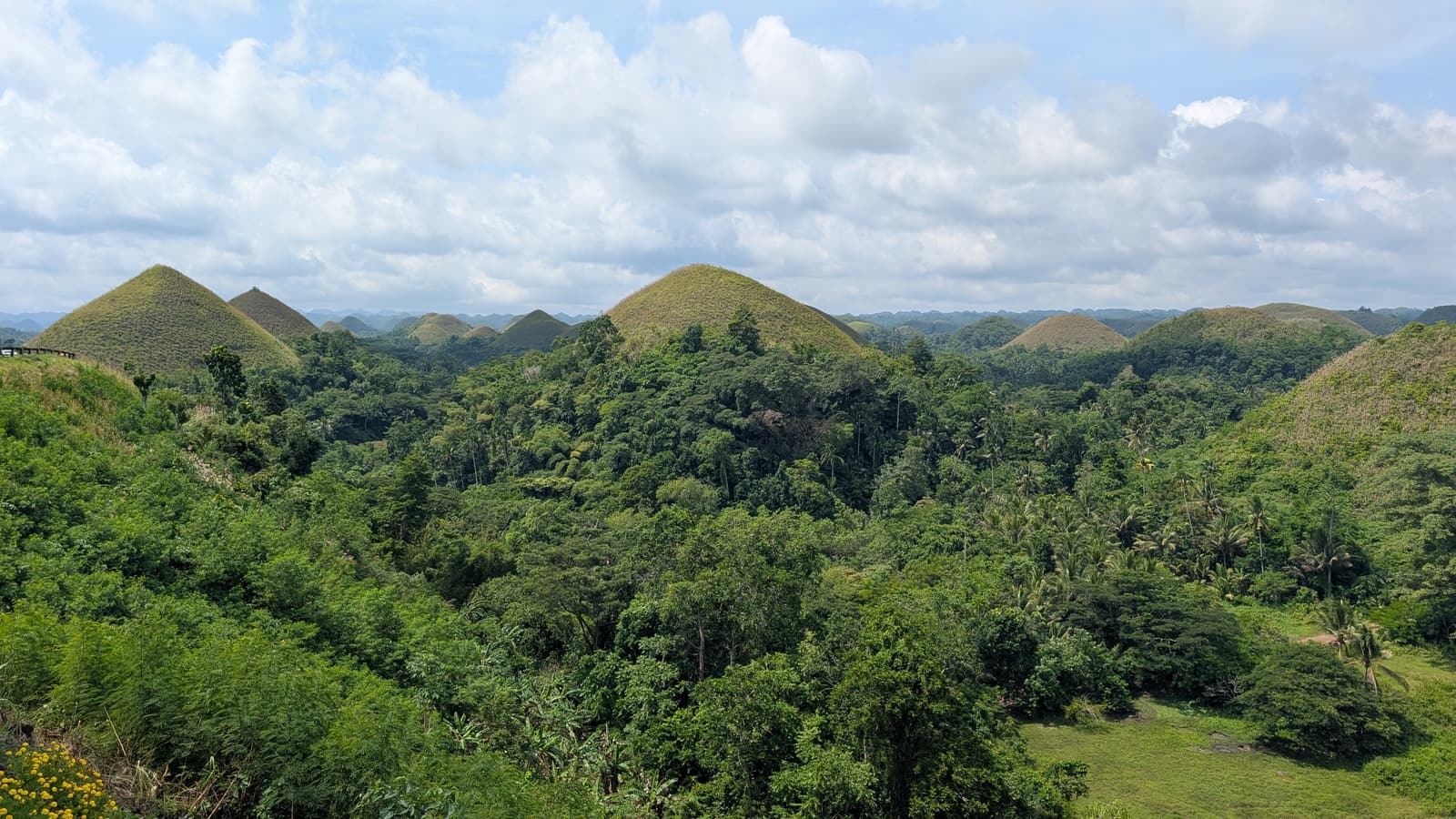
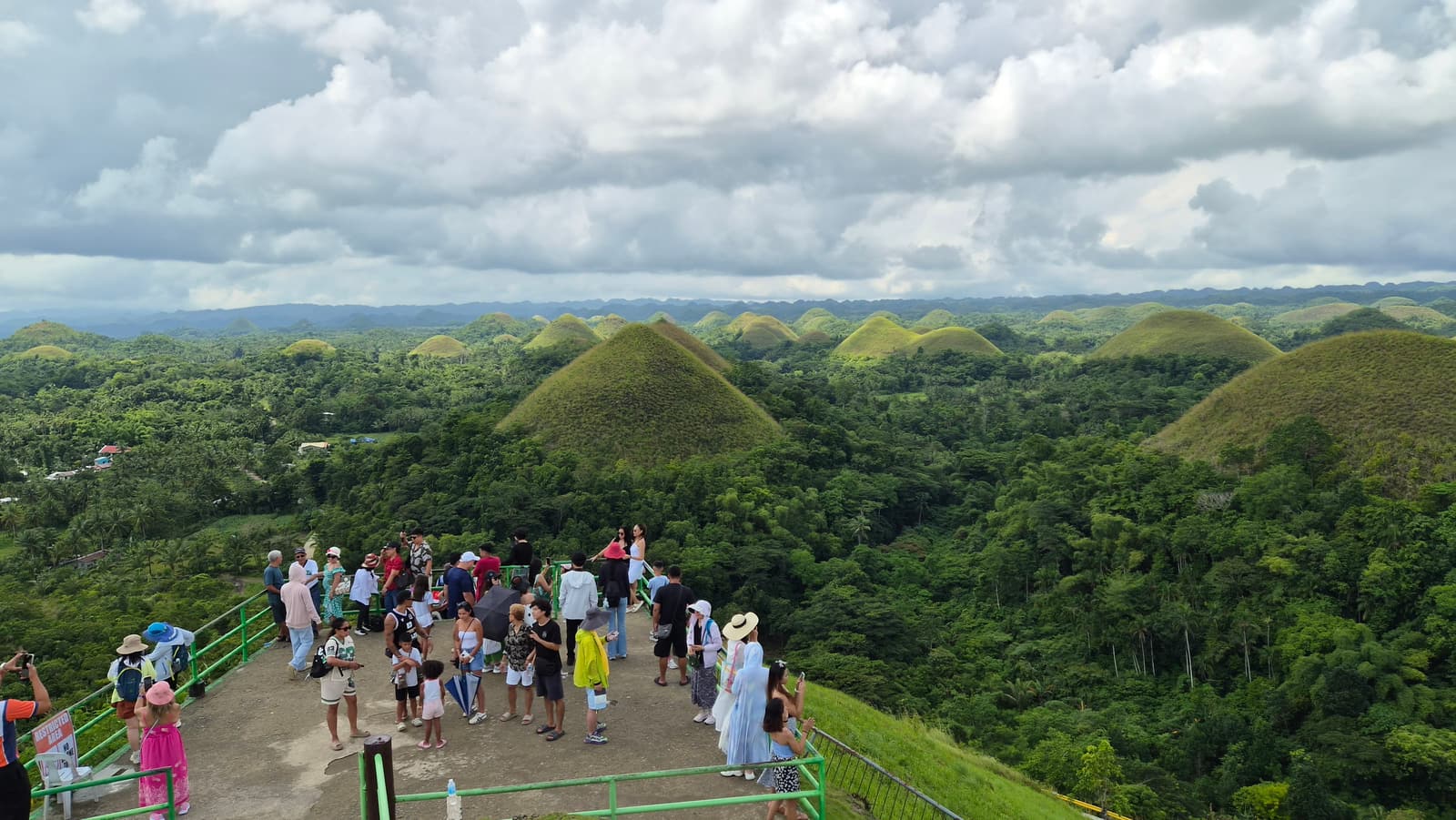
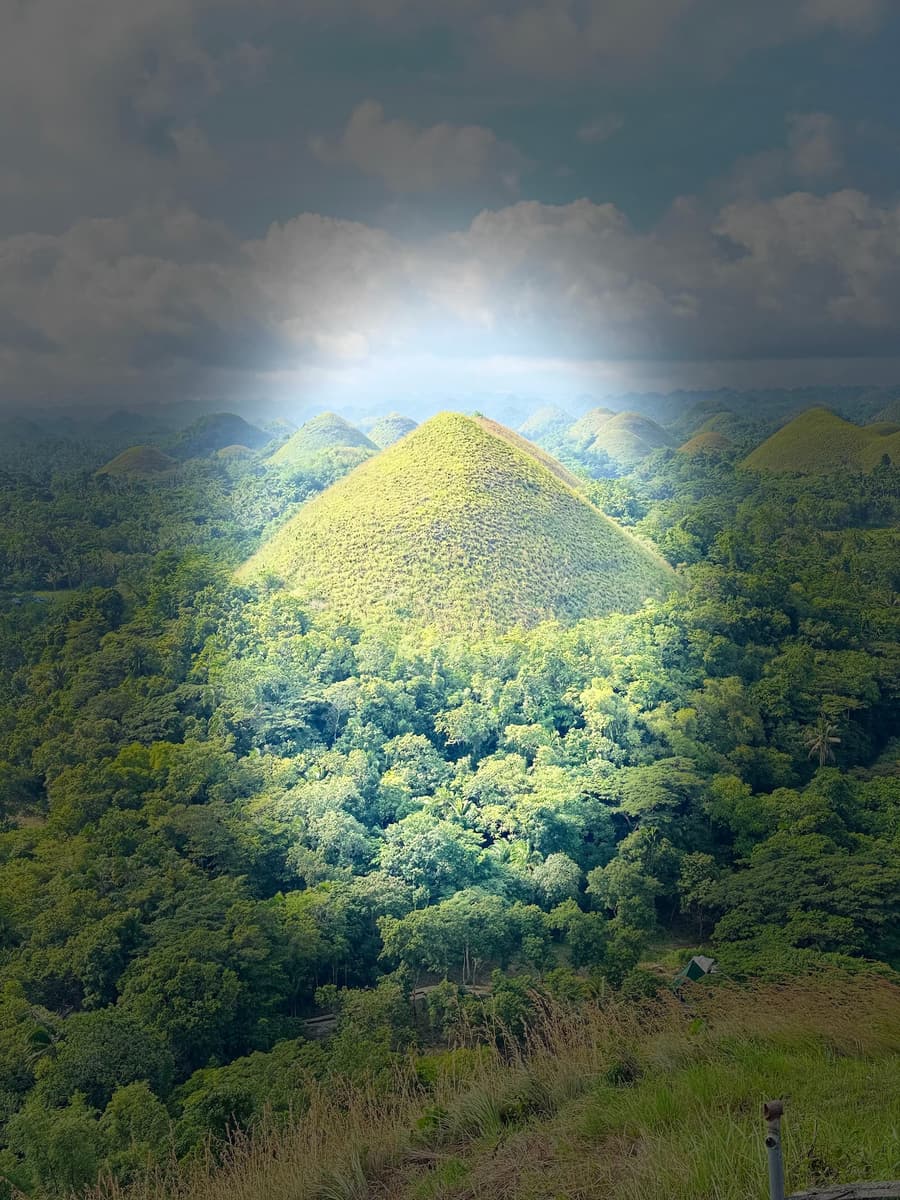
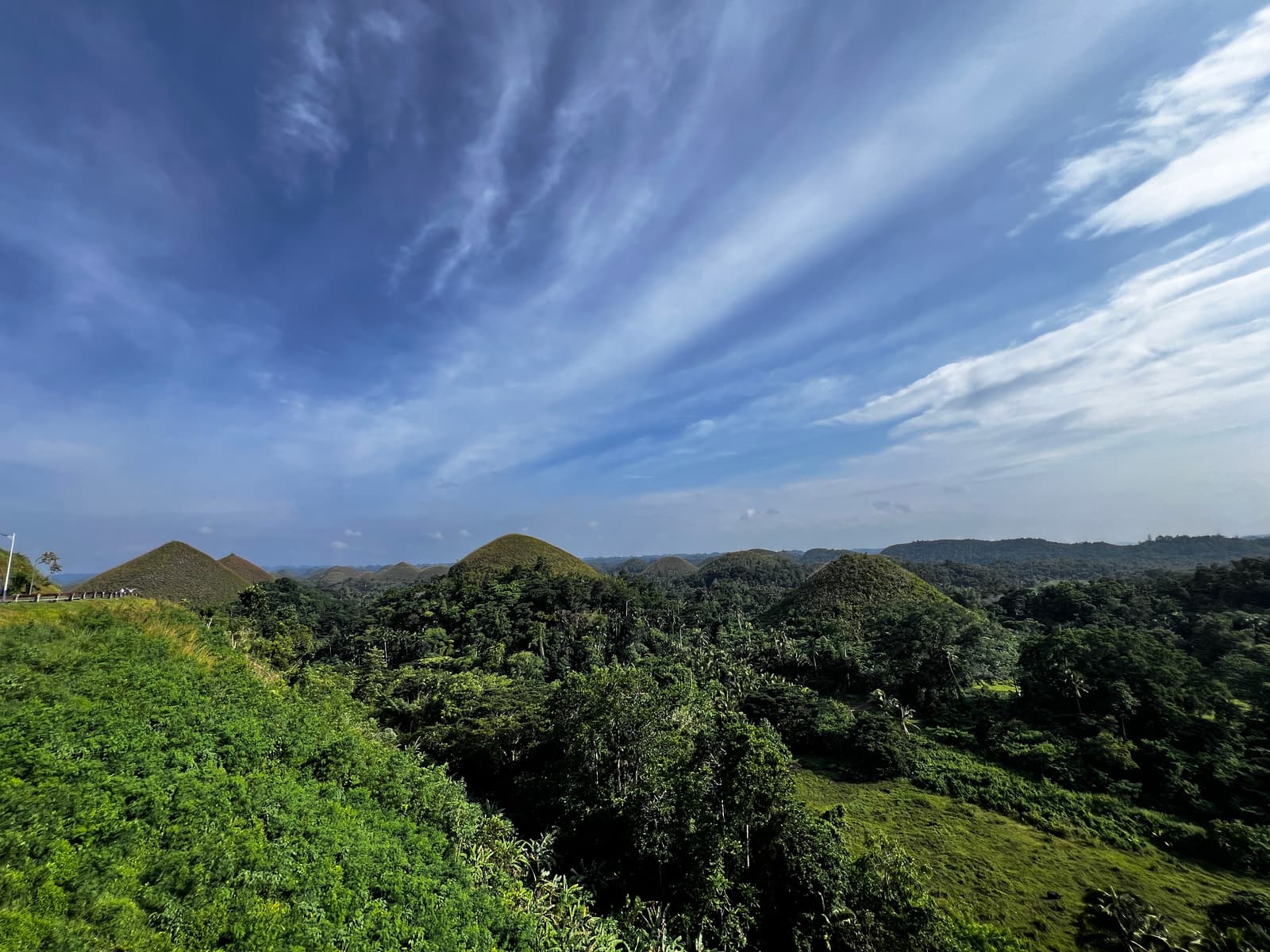
The Chocolate Hills Complex is one of the Philippines' most iconic natural landmarks — a surreal landscape of 1,268 cone-shaped hills spread across over 50 km² in central Bohol.
Rising 30–120 meters and shaped like giant truffles, these limestone formations are covered in grass that turns lush green during the rainy season and golden-chocolate brown during the dry season (January through May) — giving them their beloved nickname.
Geologists believe the hills are the eroded remnants of ancient coral reefs uplifted from the seabed millions of years ago, sculpted by rainfall and time. Locals tell a gentler legend: two giants fell in love, and when their tears dried on the earth, the hills remained.
1,268+ Conical Hills
History
History & Significance of Chocolate Hills Complex
Beyond their postcard looks, the hills hold geological, legal and cultural significance for Bohol and the Philippines.
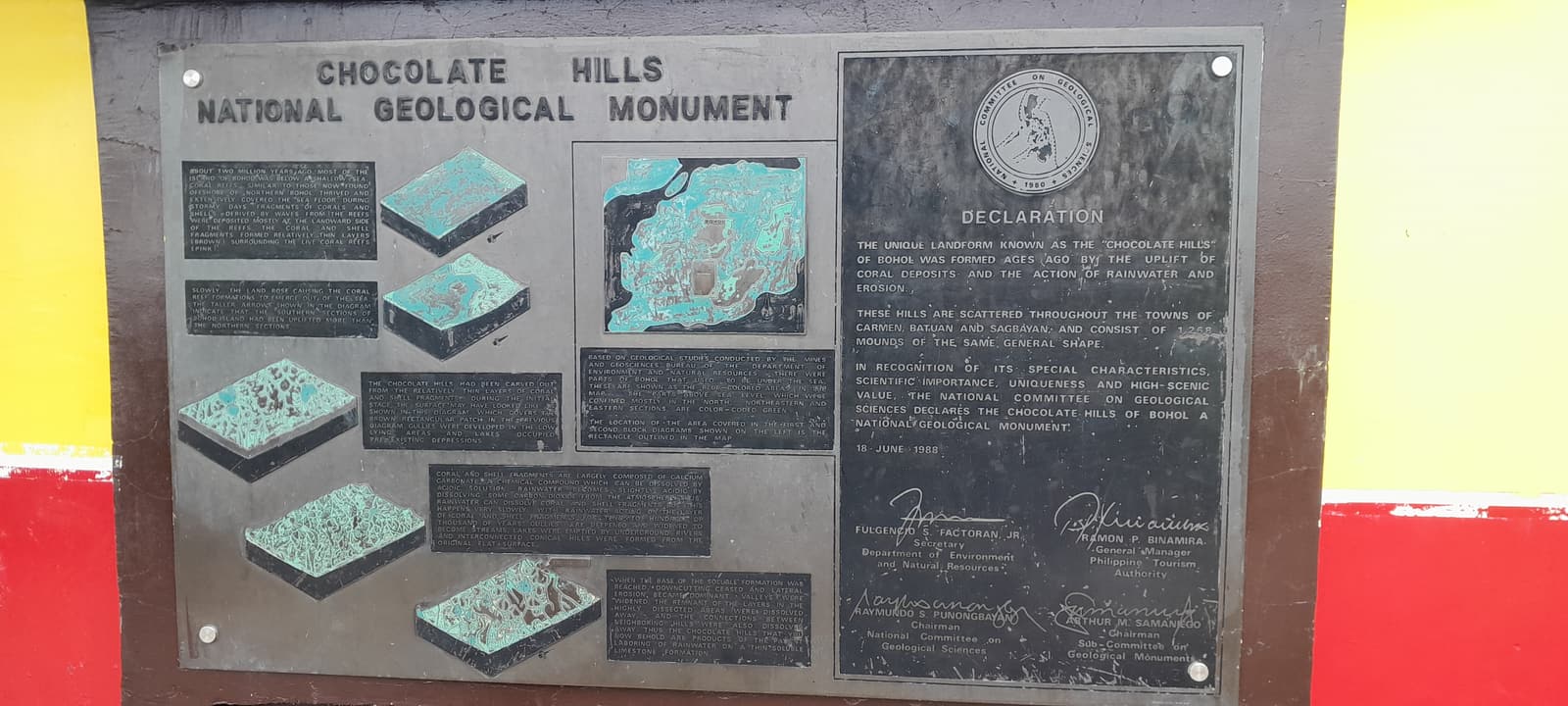
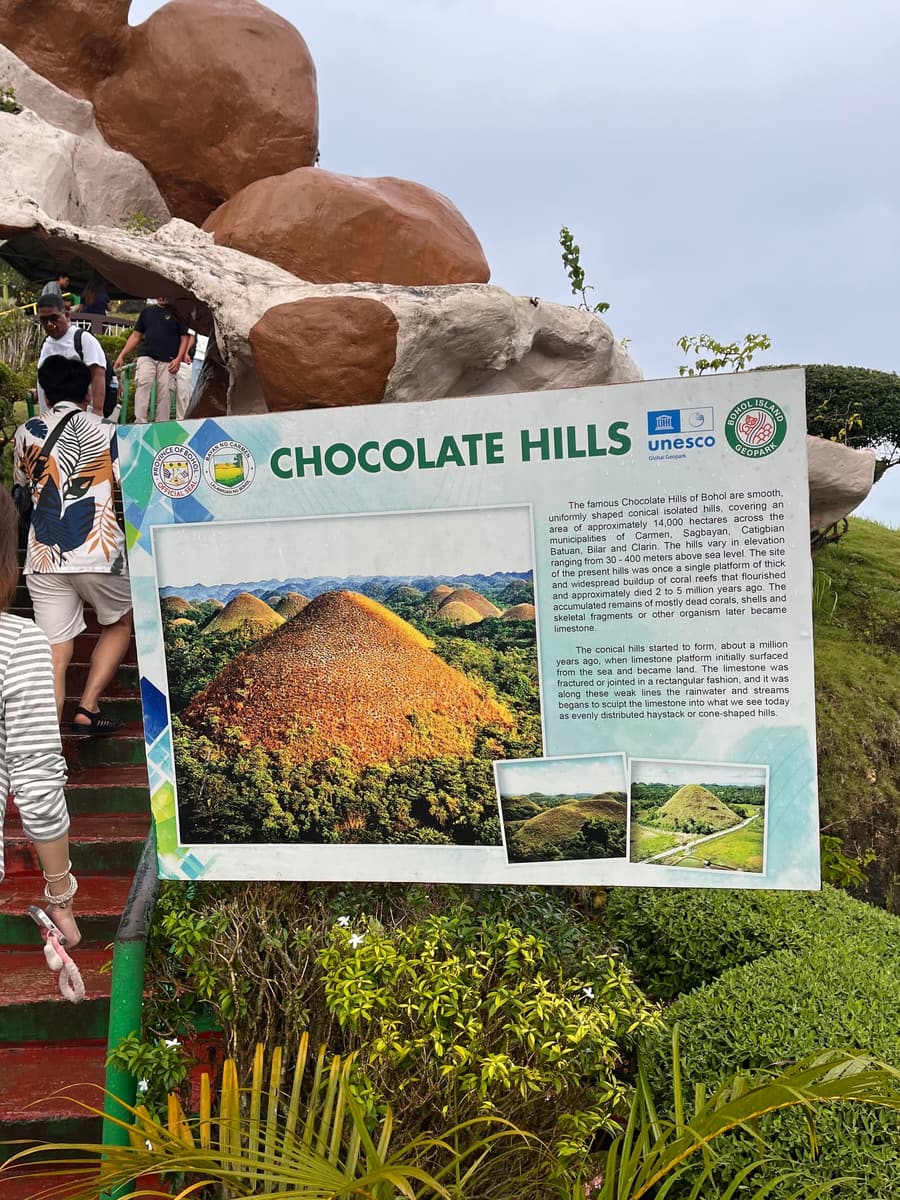
Geologists read the hills as the weathered remains of ancient coral reefs that were uplifted from the seabed and sculpted by rainfall over millions of years — a rare, textbook example of conical karst topography.
The hills were placed under national protection on 1 July 1997, when Proclamation No. 1037 established them as a national geological monument. Counts differ by method: government surveys commonly cite 1,268 hills in Carmen, while the proclamation describes about 1,776 mounds across Carmen, Batuan and Sagbayan.
Chocolate Hills Natural Monument was inscribed on the UNESCO World Heritage Tentative List in 2006, and it remains one of the Philippines' most recognizable natural icons — appearing on the provincial flag and seal of Bohol.
Key Milestones
1997Proclamation No. 1037 (1 July 1997) established the hills as a national geological monument.
2006Inscribed on the UNESCO World Heritage Tentative List as Chocolate Hills Natural Monument (16 May 2006).
TodayThe hills appear on the provincial flag and seal of Bohol and remain on the tentative list pending a full nomination.
Historical and protection status summarized from public government and UNESCO listings; see Sources & References below.
Boholano Legends
These stories are part of local folklore, passed down orally in Bohol. The geological account below is the scientific explanation.
The quarrel of two giants
One telling says two giants fought over the land, hurling boulders, sand and mud at each other for days. When they finally tired and made peace, they left the heaps behind — and those heaps became the hills.
The tears of Arogo
A gentler version tells of the giant Arogo, who wept inconsolably when his beloved Aloya died. Where his tears dried on the earth, the rounded hills remained.
What geologists see
The hills are textbook cockpit karst: marine limestone laid down on an ancient seabed was uplifted above sea level, then dissolved by slightly acidic rainwater along joints and fractures, leaving near-symmetrical cones separated by star-shaped depressions. The famous brown colour is purely seasonal — the grass cover dries out in the dry months and greens up again with the rains.
Photo Gallery
Chocolate Hills in Pictures
Click any photo to enlarge
Admission
Tickets & Entrance Fees
The Chocolate Hills Complex viewing deck is open daily (including holidays), 8:00 AM – 5:30 PM. Fees are payable at the entrance.
🧑
Adult
₱100
Non-resident
👧
Child
₱50
Non-resident
👴
Senior / PWD / Under 6
Free
With valid ID
Philippine residents enjoy lower rates with valid government-issued ID. Prices subject to change without notice.
Plan Your Visit
Best Time to Visit
🌤️
Best Season: January – May (dry season)
The hills turn golden-brown during the dry months — the iconic "chocolate" look. Clear skies make for the best panoramic photos.
🌅
Best Time of Day: 6:00 AM – 9:00 AM (cooler, fewer crowds)
Early morning offers the softest light, coolest temperatures, and fewest visitors. The 6 AM opening is ideal for photographers and peace seekers.
⏱️
Suggested Duration: 1–2 hours
Allow 15 minutes for the climb, at least 30 minutes at the viewing deck, and extra time for the café and gift shop. Combine with nearby attractions for a full day.
Seasonal Strategy
Quarter-by-Quarter Visiting Strategy
Bohol has a pronounced dry season (roughly December to May) and wet season (June to November). This table combines climate patterns with what they mean on the ground: hill colour, visibility, water and wildlife, and crowd levels.
Q1
January – March
Weather & visibility
Dry, 24–31 °C, fewest rain days; mornings clearest
Hill colour
Golden brown — the classic chocolate look
Water & wildlife
Rivers low and clear; birds most active at dawn
Crowds
High (February–April holidays)
Recommended strategy
Best overall window. Start at 6–8 AM for cool air and clean light, and book accommodation early.
Q2
April – May
Weather & visibility
Hottest months, 26–34 °C, humid with isolated afternoon showers
Hill colour
Deepest brown; grass fully dry
Water & wildlife
Wildlife keeps to shade at midday; rivers at their lowest
Crowds
Moderate to high (school holidays)
Recommended strategy
Climb very early or late afternoon, carry 1–2 litres of water per person, and expect strong sun on the stairs.
Q3
June – August
Weather & visibility
Wet-season onset; frequent afternoon and evening rain, 25–31 °C
Hill colour
Lush green — emerald rather than chocolate
Water & wildlife
Rivers and Loboc cruises at full flow; frogs and insects abundant
Crowds
Low to moderate
Recommended strategy
Plan around mornings, keep a rain shell handy, and treat the green season as a different but equally striking landscape.
Q4
September – December
Weather & visibility
Wettest, typhoon-prone window early in the quarter; drier and pleasant by December
Hill colour
Green, turning patchy brown by December
Water & wildlife
Low cloud can hide the far hills; birding is good after rain
Crowds
Low (except Christmas week)
Recommended strategy
Check weather bulletins before travelling. December often balances green hills with fewer crowds.
Seasonal patterns summarised from PAGASA climate normals for the Visayas together with protected-area guidance. Weather varies from year to year — check the forecast above before you travel.
Typhoons can affect Bohol between June and December. Always check official PAGASA bulletins and local advisories before travelling inland.
Getting Here
Location & How to Visit Chocolate Hills in Carmen
Nearest airport: Bohol-Panglao International Airport (TAG) (~70 km, ~1.5 hours by car).
Fly into Bohol-Panglao International Airport (TAG) from Manila, Cebu, Davao, or Clark. Philippine Airlines, Cebu Pacific, and AirAsia operate daily flights.
Ferry
OceanJet, 2GO, and Lite Ferries serve Tagbilaran from Cebu (2 hr fast ferry), Dumaguete, and other Visayan ports.
Bus from Tagbilaran
Take a Ceres bus from Dao Integrated Bus Terminal in Tagbilaran bound for Carmen. Journey takes 60–90 minutes. Fare: ~₱80–120.
Van / Private Car
Vans depart from Tagbilaran City to Carmen. Private car hire or taxi from Tagbilaran costs ₱2,000–3,000 one-way.
Motorcycle (Habal-Habal)
From Carmen town proper, take a habal-habal (motorcycle taxi) to the Chocolate Hills Complex (~10 min, ₱50–100). Also available from Tagbilaran for the adventurous (~1.5 hrs).
Tricycle
Tricycles from Carmen town to the viewing deck take approximately 10–15 minutes, costing ₱100–150 round trip.
Scooter Rental
Rent a scooter in Panglao or Tagbilaran (₱350–600/day). The scenic 1.5-hour ride passes through Bilar Man-Made Forest.
Route Planner
How to Get Here: Airport, Pier, Bus, Taxi & Self-Drive
Step-by-step routes to the Chocolate Hills Complex in Carmen, with indicative journey times and fares for each option.
Bohol-Panglao International Airport (TAG)
~70 km Journey time: 1.5 – 2 hours Indicative fare: ₱2,500–3,500 per vehicle (charter)
How to do it
Door to door: take a pre-booked van or airport taxi straight to the complex — the simplest option with luggage.
Budget route: airport shuttle or tricycle to Tagbilaran, then a bus to Carmen, then a tricycle to the hills.
After a late arrival, overnight in Panglao or Tagbilaran and travel inland the next morning — last-mile transport thins out after sunset.
Tagbilaran seaport (ferry from Cebu, Dumaguete, Siquijor)
~55 km Journey time: 1.25 – 1.75 hours Indicative fare: ₱80–120 bus + ₱100–150 tricycle
How to do it
Tricycle from the pier to Dao Integrated Bus Terminal (about 10 minutes).
Bus or public van to Carmen town proper (60–90 minutes).
Tricycle from Carmen town to the complex (10–15 minutes).
Fast ferries from Cebu arrive early enough to reach the hills before the midday crowds if you travel light.
Tagbilaran city or Panglao hotels (public transport)
~55–75 km Journey time: 1.5 – 2 hours Indicative fare: ₱80–120 per person, each way
How to do it
Tricycle or jeepney to Dao Integrated Bus Terminal in Tagbilaran.
Ceres bus or public van bound for Carmen, Sagbayan or Batuan; tell the conductor you are getting off at Carmen town.
Tricycle from Carmen town up to the viewing-deck entrance.
Services thin out in the late afternoon — ask for the last return departure before you start the day.
Taxi, ride-hailing or chartered van
From Panglao or Tagbilaran Journey time: 1.5 hours each way Indicative fare: ₱2,000–3,000 one way; more with waiting time
How to do it
Agree a round-trip rate (including waiting time) before departure rather than using a meter.
Chartering a van with driver is usually the best value for groups of four or more.
Ride-hailing coverage is concentrated around Tagbilaran and Panglao; inland Carmen relies on tricycles and charters.
Motorbike taxi (habal-habal) & tricycle
Last mile from Carmen town Journey time: 10 – 15 minutes Indicative fare: ₱50–100 habal-habal; ₱100–150 tricycle round trip
How to do it
From Carmen town proper, hire a tricycle or habal-habal to the complex entrance.
Negotiate a round trip and waiting time — there is no queue of returning vehicles at the top.
Ideal if you arrive by bus: agree the return fare first so you are not stranded after your visit.
Self-drive or rental scooter
~55–75 km from Panglao Journey time: 1.5 hours Indicative fare: ₱350–600 per day (scooter) plus fuel
How to do it
Rent in Panglao or Tagbilaran and take the Tagbilaran–Carmen road via Bilar and the man-made forest.
Park at the complex lot; keep your helmet and valuables with you.
Carry a licence and helmet, watch for tractors, dogs and cattle on inland roads, and slow down on rain-slicked bends.
Organised countryside tour
Hotel pick-up included Journey time: Full day, 8–10 hours Indicative fare: Varies by group size and inclusions
How to do it
Join a Bohol countryside circuit that typically pairs the hills with a tarsier sanctuary, a river cruise and the man-made forest.
Confirm whether entrance fees, lunch and the Loboc cruise are included.
Convenient and efficient, but schedules are fixed — choose a small-group tour if you want time for photography.
Fares and timetables are indicative and change without notice — confirm locally or through your accommodation before you set out.
Parking
Parking Information
🚗
On-site Parking Available
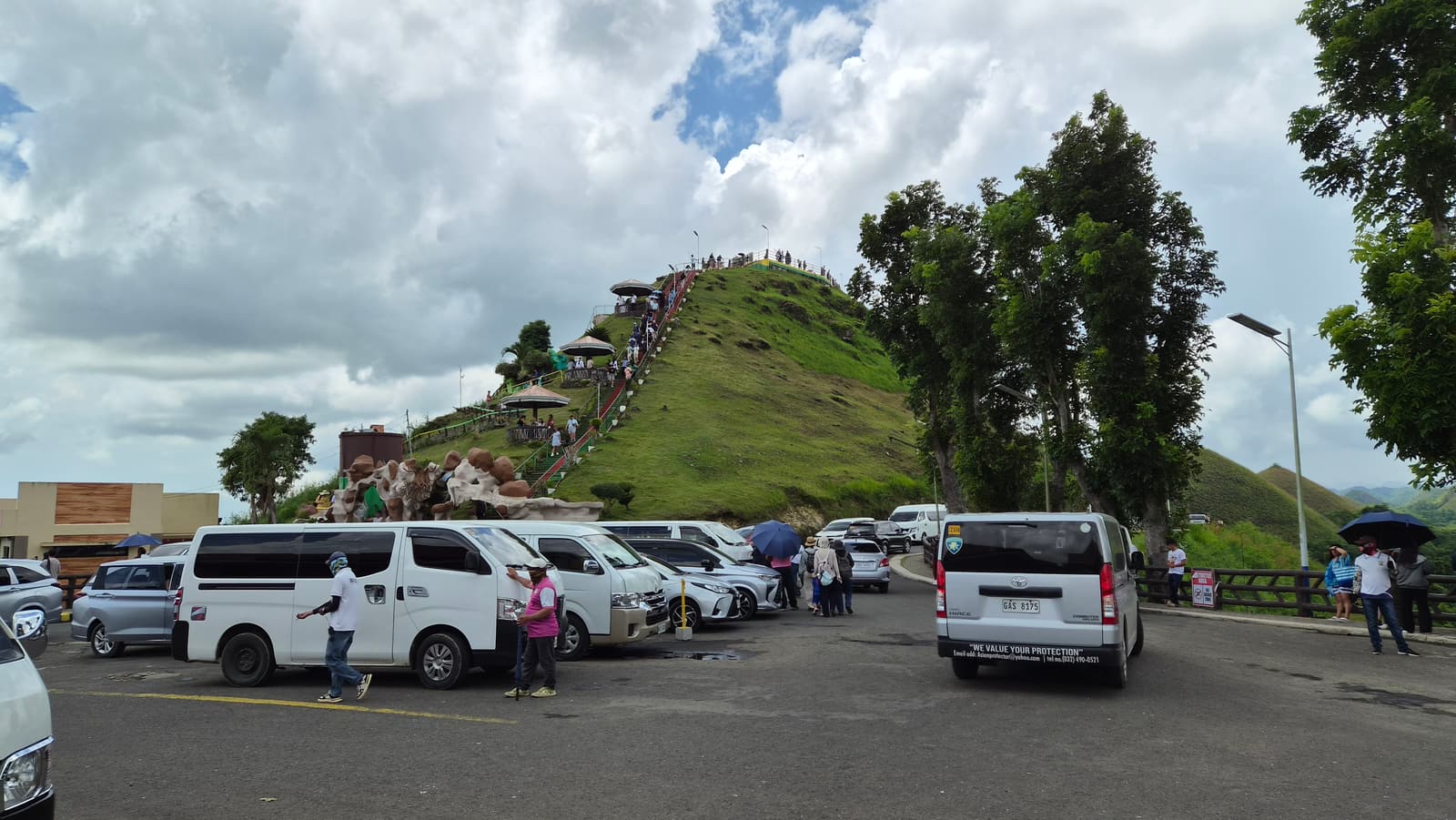
Spacious parking lot for buses, vans, cars, and motorcycles
Fee:₱20–50 per vehicle
Tips:Parking attendants are available. Arrive early (before 9 AM) for the best spots, especially on weekends and holidays.
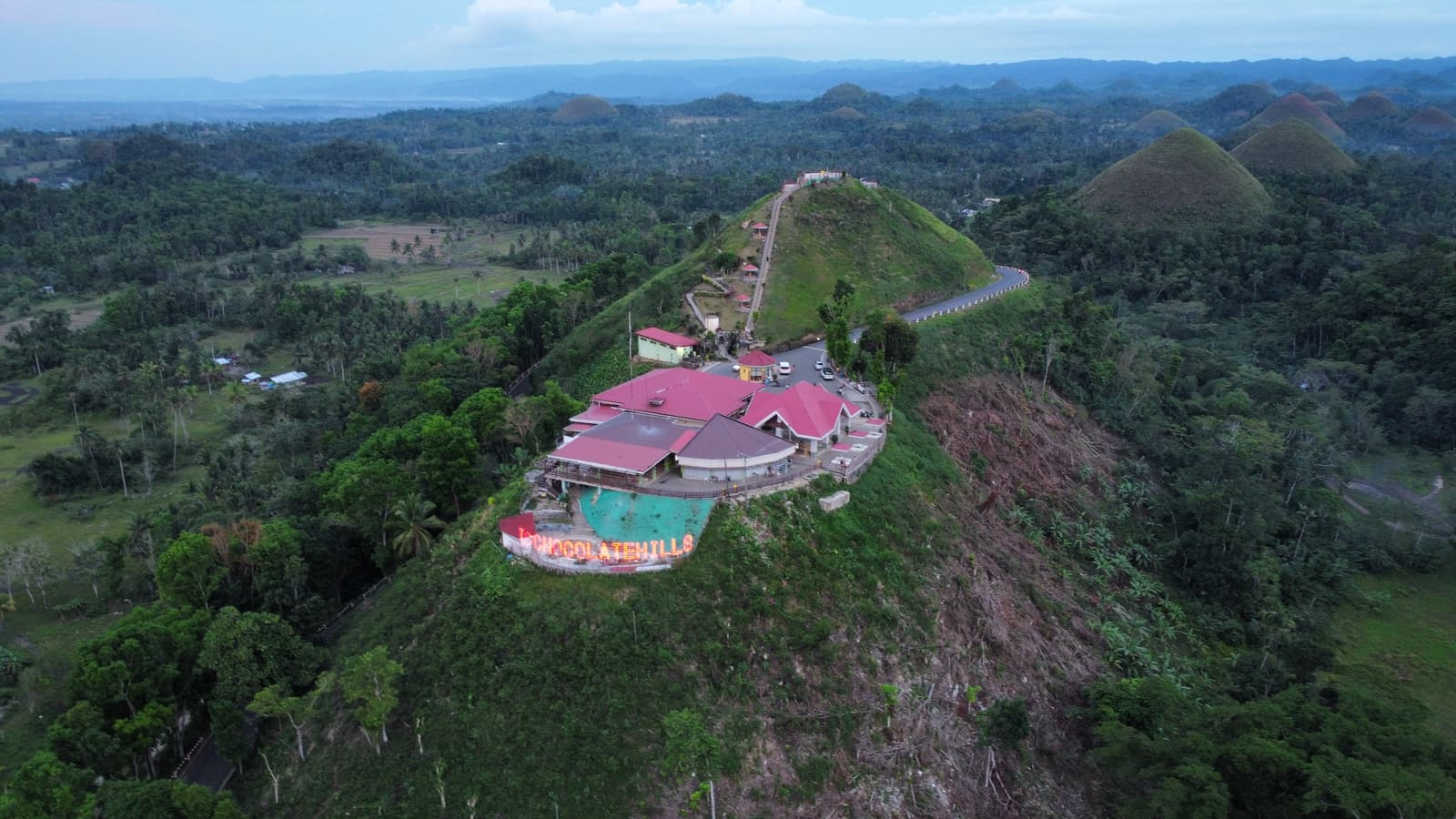
Located at the complex itself. Serves Filipino comfort food and refreshments with a view.
Loboc River Floating Restaurant
~25 km
Filipino Buffet
Enjoy a buffet lunch while cruising the scenic Loboc River. A classic Bohol experience. ₱850/person.
Buzz Café Bohol
~40 km (in Baclayon)
Organic Café
Bee-farm inspired café serving organic ice cream, salads, and pastries with sea views.
Gerarda's Restaurant
~50 km (in Tagbilaran)
Filipino Fine Dining
Heritage house turned restaurant. Famous for crispy pata, kinilaw, and seafood platters.
Trudi's Place
~6 km (in Carmen town)
Local Filipino
A homegrown eatery popular with locals. Serves affordable meals like adobo, sinigang, and grilled fish.
JMJ Eatery
~5 km (in Carmen town)
Local Filipino
Simple carinderia-style dining. Great for a quick, budget-friendly meal after visiting the hills.
Explore More
Landmarks & Attractions Around Chocolate Hills
Make the most of your Bohol adventure — these attractions are all within driving distance of the Chocolate Hills.
When visiting Chocolate Hills Complex, visitors can easily explore surrounding historical landmarks and points of interest, including Chocolate Hills Adventure Park and Bilar Man-Made Forest.
~1 km
Chocolate Hills Adventure Park
Zipline, bike zip, and rope courses with hills views. The "Bike Zip" ride is a highlight. Entrance from ₱100.
~15 km
Bilar Man-Made Forest
A 2-km stretch of dense mahogany trees along the highway. Beautiful photo stop and ecological landmark.
~30 km (in Loboc)
Tarsier Conservation Area
See the world's smallest primates — Philippine tarsiers — in a protected sanctuary. Entry ₱60.
~25 km
Loboc River Cruise
Floating restaurant cruise with live music through the scenic Loboc River. Includes buffet lunch.
~20 km
Sipatan Twin Hanging Bridge
Bamboo suspension bridge across the Loboc River. Souvenir shops and fresh buko (coconut) juice at both ends.
~45 km
Baclayon Church
One of the oldest stone churches in the Philippines (1727). A National Cultural Treasure near Tagbilaran.
~75 km (in Dauis)
Hinagdanan Cave
Limestone cave with a natural underground pool. Great for a refreshing swim. Entrance ₱50.
~80 km
Panglao Island & Alona Beach
White-sand beaches, diving, island hopping, and vibrant nightlife. The perfect beach complement to the hills.
Visitor Services
Visitor Services & Facilities
A type-by-type overview of what to expect at the complex and in Carmen town. This is an independent, non-commercial reference site: we describe categories of service, not individual businesses.
Restrooms & washrooms
Public restrooms are available at the complex near the entrance and parking area, with further facilities at the café.
Facilities are basic and busiest mid-morning — carry tissues and hand sanitiser.
Parking
A large on-site lot serves cars, vans, motorbikes and tour buses, with attendants directing traffic.
Budget ₱20–50 per vehicle and arrive before 9 AM on weekends and holidays.
Food & drinks
An on-site café serves simple Filipino meals, snacks and cold drinks; Carmen town (5–6 km away) has small local eateries.
Vegetarian, halal and allergen-specific options are limited inland — eat first if your requirements are strict.
Drinking water & shade
Bottled water is sold at the complex; refill points are limited, and shade is mostly at the lower complex and café.
Bring a refillable bottle — the stairway to the viewing deck is fully exposed.
Accommodation
Most visitors stay in Tagbilaran or Panglao (70–80 km away). Carmen and nearby inland towns also have small inns, guesthouses and homestays.
Reserve ahead for December to May; inland rooms are few and usually family-run.
Groceries & convenience
Small neighbourhood stores in Carmen town sell water, snacks, basic toiletries and mobile load; full supermarkets are in Tagbilaran.
Stock up in Tagbilaran if you need specific items such as baby supplies or sports drinks.
Fuel & charging
Fuel stations operate along the Tagbilaran–Carmen road and in Carmen town. Public charging for electric vehicles remains very limited in inland Bohol.
Fill up before heading inland, and plan charging around Tagbilaran or Panglao.
Cash, ATMs & connectivity
Entrance fees, parking and tricycle fares are paid in cash. ATMs and banks are concentrated in Tagbilaran and larger towns.
Bring small bills; mobile signal at the complex is usable but data speeds vary.
First aid & medical
Basic first-aid assistance is available at the complex; pharmacies are in Carmen town and hospitals are in Tagbilaran.
Carry personal medication and a small kit — the nearest hospital is more than an hour away.
Accessibility
The lower complex, parking area and café are step-free; the 214-step stairway to the viewing deck is not wheelchair accessible.
Visitors with limited mobility can still enjoy ground-level views — ask staff about the flattest routes and rest points.
Souvenirs & local products
Stalls near the entrance sell handicrafts, T-shirts and Bohol food specialties such as calamay and peanut kisses.
Town markets usually price the same items lower than attraction-side stalls.
Facilities change with the seasons and during holidays; treat distances and prices as indicative only.
Suggested Routes
Recommended Half-Day & Full-Day Routes
Two ready-made loops from Tagbilaran or Panglao, built around opening hours, daylight and inland road conditions.
Half-day loop (about 6 hours)
Best if you are based in Panglao or Tagbilaran and want a beach afternoon
06:30Depart Tagbilaran or Panglao by private car, van or tour.
08:00Arrive at Chocolate Hills Complex and climb to the viewing deck before the heat builds.
10:00Cold drinks and a light snack at the complex; browse the souvenir stalls.
10:45Photo stop at the Bilar Man-Made Forest on the way back.
12:30Lunch in Loboc or back in Tagbilaran.
Full-day countryside loop (about 9–10 hours)
Best if the hills are the highlight of your Bohol day
06:00Depart from Panglao or Tagbilaran.
07:30Chocolate Hills Complex — climb early for cool air and soft light.
09:30Adventure park next door for a zipline or bike-zip run.
11:00Short stop at the Bilar Man-Made Forest.
11:30Tarsier sanctuary visit (quiet voices, no flash).
12:30Lunch, ideally a Loboc river cruise.
14:30Twin hanging bridge and riverside souvenir stops.
15:30Historic Baclayon Church near Tagbilaran.
17:30Return to your hotel.
Inland roads are unlit and the complex closes at 5:30 PM — plan to be back on the main highway before dusk.
Tailored Plans
Three Plans by Traveller Type
Pick the plan that matches who you are travelling with and how much of the day you want to spend.
Families with children
Travelling with children under 12
Half day, 3–4 hours
•Arrive at opening time and climb the 214 steps slowly, using the landings as rest stops.
•Pair the visit with a short stop at the man-made forest and an early, unhurried lunch.
•Keep transfers short: children usually enjoy the viewing deck more than long drives.
✓Strollers are impractical on the stairway — a child carrier works better for toddlers.
✓Sun hats, water and snacks matter far more than spare clothes.
Photography & nature
Photographers, birders and geology enthusiasts
Half day to full day
•Sunrise and late afternoon light rakes across the cones and reveals their shape; midday light flattens them.
•A short telephoto compresses the hill layers, while a wide lens suits the panorama from the deck.
•Weekdays and the green season give the emptiest frames.
✓Ask site staff about current drone rules before flying — restrictions apply in protected areas and over crowds.
✓Bring a lens cloth: sea haze and sudden showers are common.
Low-mobility & senior visitors
Wheelchair users, seniors, anyone avoiding stairs
1–2 hours at ground level
•The parking area, lower complex, café and gardens are step-free and open to the hills.
•Early morning or late afternoon keeps temperatures manageable.
•Companions can take turns on the stairway while others rest in the shade.
✓The 214-step deck is not wheelchair accessible — plan around ground-level viewpoints.
✓Ask to be dropped close to the entrance; walkways are firm but uneven after rain.
Plan Ahead
Your Bohol Itinerary Checklist
Check off the spots you want to visit. Your selections are saved on this device only — no data leaves your browser.
0 of 10 selected
Science & Stewardship
Science of the Hills & Visitor Responsibility
A protected landscape rather than a playground. Knowing how the hills formed explains why a few simple rules matter.
How the hills formed
The hills are textbook cockpit karst: marine limestone laid down on an ancient seabed was uplifted above sea level, then dissolved by slightly acidic rainwater along joints and fractures. What remains is a field of near-symmetrical cones separated by star-shaped depressions. The famous brown colour is purely seasonal — the grass cover dries out during the dry months and greens up again with the rains.
Why they are protected
Proclamation No. 1037 (1997) established the hills as a national geological monument, and the Chocolate Hills Natural Monument has been on the UNESCO World Heritage Tentative List since 2006. Protection covers the landform itself: quarrying, digging, building and climbing the cones damage surfaces that took thousands of years to form.
Please do
✓Stay on marked paths and viewing areas — the slopes are fragile and erode quickly.
✓Carry out all rubbish: bins are limited and wind blows litter onto the slopes.
✓Keep voices and music low; the area is habitat for birds and other wildlife.
✓Pay official fees and choose accredited sanctuaries so conservation work is funded.
✓Ask before photographing people, and never use flash on nocturnal animals such as tarsiers.
Please avoid
✕Climbing the hills or walking off-trail — it damages grass cover and loose limestone.
✕Collecting rocks, plants or souvenirs from the slopes; removing material is prohibited in protected areas.
✕Flying drones without checking current site and local rules; launches are restricted in many protected areas.
✕Lighting fires, smoking outside designated areas, or leaving food waste that attracts animals.
✕Trampling or cutting vegetation to frame a photo — a single damaged patch can scar for seasons.
This is an independent, non-commercial reference site. We do not sell tickets or tours and are not affiliated with the site operator or any government body.
Visitor Ratings
Google Maps Reviews for Chocolate Hills Complex
4.5
4.5 out of 5 · 10,410 reviews
Google Maps rating
Reviews from Google Maps users · View all Google Maps reviews
The complex is open daily, including holidays, from 8:00 AM to 5:30 PM. The 214-step stairway and the viewing deck are fully exposed, so the coolest and clearest window is early morning, right after opening.
It closes at 5:30 PM. Arrive by 4:30 PM at the latest — the climb up takes 10–15 minutes and you will want another 30 minutes on the deck for photos.
As of 2026: ₱100 for adult non-residents and ₱50 for children. Senior citizens, PWDs and children under 6 enter free, and Philippine residents pay lower rates with a valid ID. Parking is ₱20–50 per vehicle.
The address is Q5X8+FX4, Loay Interior Road, Carmen, Bohol 6319, Philippines (9.7988° N, 124.1648° E). It sits about 55 km from Tagbilaran City and 70 km from Bohol-Panglao International Airport (TAG) — roughly 1.5 hours by road.
From Tagbilaran, take a Ceres bus or van from Dao Integrated Bus Terminal to Carmen (60–90 minutes, ₱80–120), then a tricycle to the complex (10–15 minutes, ₱100–150 round trip). From Panglao, most visitors join a countryside tour or hire a van (₱2,000–3,000 one way).
During the dry season (January–May), the grass covering the 1,268 conical hills turns brown, making them look like giant chocolate truffles scattered across the landscape — hence the name.
The Philippine government officially counts 1,268 cone-shaped hills spread over 50 km² across Carmen, Batuan, and Sagbayan. Some surveys report up to 1,776 hills.
Geologists believe the hills are weathered limestone formations from coral deposits that uplifted from the sea millions of years ago, shaped by millennia of rainfall and erosion.
There are 214 steps leading to the main viewing deck at the Chocolate Hills Complex in Carmen. The climb takes about 10–15 minutes at a moderate pace.
Arrive as early as 6:00–7:00 AM. You'll enjoy cooler temperatures, softer light for photos, and fewer tourists. Weekdays are significantly less crowded than weekends.
Yes, the complex has a large parking area that accommodates cars, vans, motorcycles, and tour buses. Parking fee is ₱20–50.
Yes — the hills are lush green in the rainy season (June–December). While they won't look "chocolatey," the green landscape is equally stunning in its own way.
Unfortunately, the 214-step staircase to the viewing deck is not wheelchair accessible. However, the lower complex area and parking lot are accessible.
Wear comfortable shoes for the steps, bring water, a hat or umbrella for sun protection, and a camera. Light snacks are available at the complex.
References
Sources & References
This guide is compiled from public, authoritative sources. Ratings and reviews are quoted from Google Maps and are not submitted through this website.